
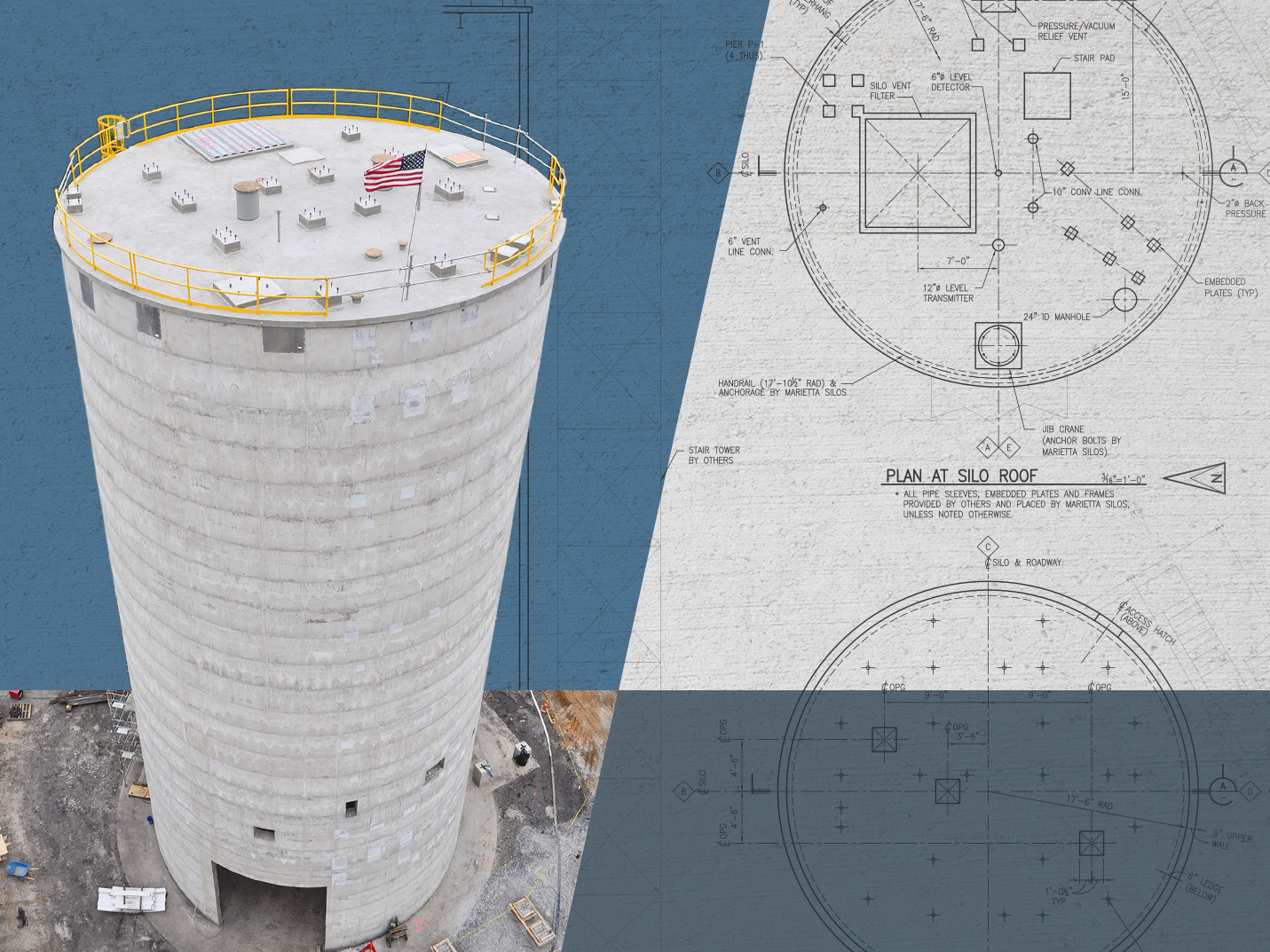
Silos are deceptively simple from the outside, but they’re heavily loaded structures that store enormous weights of material, sit in environments full of combustible dust, and require people to enter confined spaces to service them. Each of those facts carries a regulatory consequence. For over a century, Marietta Silos has engineered, built, inspected, and restored concrete silos for industries from cement and mining to power and manufacturing – work that sits squarely within several demanding regulatory frameworks. Here are the key codes that shape every silo project.
ACI 313-16: The Design Foundation
Every well-built concrete silo starts with a design that meets ACI 313-16, the Design Specification for Concrete Silos and Stacking Tubes for Storing Granular Materials. It captures loading conditions ordinary building codes don’t – funnel, mass, concentric, and asymmetric flow, plus seismic and hopper bottom design. Marietta Silos designs every silo to the current ACI 313-16 standard and is a member of the ACI Committee, keeping its team ahead of code updates. Designing to code from the start is the single most important compliance decision in a silo’s life.
OSHA 1910.272: Grain Handling Facilities
Once a silo operates, the focus shifts to worker safety. OSHA 29 CFR 1910.272 addresses fires, explosions, engulfment, and hazardous atmospheres in grain and bulk material handling. Its impact is measurable: a retrospective OSHA review found it reduced grain explosion injuries by 55% and deaths by 70%, and suffocation deaths by 44%. Key provisions govern entry into grain storage structures (permits, trained observers, body harnesses with lifelines) and ignition control near combustible dust.
OSHA 1910.146: Confined Space Entry
Once a silo operates, the focus shifts to worker safety. OSHA 29 CFR 1910.272 addresses fires, explosions, engulfment, and hazardous atmospheres in grain and bulk material handling. Its impact is measurable: a retrospective OSHA review found it reduced grain explosion injuries by 55% and deaths by 70%, and suffocation deaths by 44%. Key provisions govern entry into grain storage structures (permits, trained observers, body harnesses with lifelines) and ignition control near combustible dust.
OSHA 1910.146: Confined Space Entry
Silos are confined spaces by definition, bringing them under OSHA 29 CFR 1910.146, the permit-required confined spaces standard. A silo that can bridge, flow, or hold combustible dust easily meets the “permit-required” threshold. Compliance means atmospheric testing before and during entry (oxygen, then combustibles, then toxics), continuous monitoring, a written permit program, trained attendants, and rescue procedures in place before anyone enters.
NFPA 652: Combustible Dust
Many stored materials – cement, coal, fly ash, grain products — generate combustible dust. Dispersed at the right concentration inside an enclosed silo with an ignition source, that dust can explode. OSHA’s combustible dust framework draws on NFPA 652 and commodity-specific standards like NFPA 654, which outline how to characterize dust and manage the hazard through engineering controls, housekeeping, and ignition control. OSHA can also cite employers under the General Duty Clause when these hazards aren’t adequately controlled.
How Marietta Silos Keeps It All Together
Compliance isn’t a single document – it’s a continuous discipline from the first drawing through decades of operation. Marietta Silos’ approach reflects that:
- Design to code from day one, with foundations engineered for soil, load, drainage, and environmental conditions.
- Active standards involvement as an ACI committee member, staying ahead of revisions.
- Safety-first field operations aligned with OSHA confined space, fall protection, and structural safety requirements.
- End-to-end service under one roof – engineering, construction, inspection, cleaning, and restoration treated as one connected lifecycle rather than isolated tasks.
Regular inspection is what keeps a code-built silo compliant over time, catching cracking, wall thinning, liner wear, and foundation movement before they become failures.
The Takeaway
The silo regulatory landscape is real and detailed: ACI 313-16 for design, OSHA 1910.272 for handling operations, OSHA 1910.146 for confined space entry, and NFPA combustible dust standards for explosion risk. Build to code. Inspect on a schedule. Enter confined spaces only with a proper permit program. Manage combustible dust deliberately. And work with partners who treat compliance as a culture, not a checklist — which is exactly what Marietta Silos brings to every project.
Learn more at mariettasilos.com.